
Real Estate & Business Securities Law
Real Estate Syndication Attorneys for Sponsors and Fund Managers
We design the deal first, then draft the documents - deal structuring is where we're strongest.
Deal structuring experts
Entity formation and operating agreements
Private placement memorandum
Form D and blue sky filings
Advertising compliance support
Post offering support included
We'll tell you how we can help.

500+
securities offerings
$5B+
raised by our clients
10+ yrs
securities law only
2
Amazon #1 best-sellers
Who this is for
Is this the right page for you?
Deal Under Contract
You've got a property or business locked up and a closing date setting your document deadline.
Next Deal, Better Documents
You've syndicated before and want documents that hold up better than last time.
Several Deals a Year, or a Fund
You're doing enough volume that a repeatable structure - or a fund - makes more sense than one-off documents.
Raising Without an Offering
You're already talking to investors and need to get compliant before you take a dollar.
Already working with a securities attorney on an active offering? Loop in your existing counsel - we're happy to coordinate.
The basics
Syndication or fund?
Not every raise needs the same structure. Here's how a straight syndication, a Series LLC, a fund, and a fund of funds typically compare.
Investors buy
Best for
Raising
Pricing starting at*
Syndication
A direct interest in one asset or deal
A single property or business raise
One offering, one closing
$15,000
Series LLC
A membership interest in one series tied to one deal
Sponsors doing multiple deals a year who want separate investors in each deal.
Each series raises and closes on its own timeline
$15,000
Fund
A membership interest in a pool of current or future deals
Raising ahead of specific deals, or investing across several; best for sponsors with a track record and high deal flow.
Ongoing or periodic raises depending on the fund's structure
$25,000
Fund of Funds
A membership interest in a fund that invests in other sponsors' deals
Investors who want diversified exposure across sponsors without sourcing deals themselves
Ongoing or periodic raises as new underlying deals are added
$12,500
Investment Club
A pooled interest in whatever the club decides to invest in together
Groups of friends or colleagues investing together - still subject to securities law if any member is passive
Contributions as members join or add capital to the pool
$12,500
Reg CF
Securities offered to the general public, including non-accredited investors, through an SEC/FINRA-approved platform
Raisers who want to advertise and accept non-sophisticated investors
One offering through an approved platform; audits required over certain raise amounts
$15,000
Reg A+
Securities offered publicly to anyone, including non-sophisticated investors, after SEC pre-approval
Larger raises that want to advertise to anyone, including non-sophisticated investors
Up to $75M/year (Tier 2); audits required; plan on 4-6 months for submission and pre-approval
$65,000
*Starting prices for standard engagements. Excludes Blue Sky filings and entity formation fees, which are billed separately. Your exact fee depends on the scope of your matter and is confirmed in a written quote. Reg CF and Reg A+ also involve third-party costs such as auditing, transfer agent, and platform fees.
The package
What's included
Private Placement Memorandum
The disclosure document itself - risks, structure, fees, and terms.
Two Operating Agreements
Governance for both the offering entity and any series or subsidiary it holds.
Subscription Agreement
The contract each investor signs to commit their money.
Investor Questionnaire
Confirms investor suitability for the exemption
Form D Filing Support
The notice filed with the SEC within 15 days of your first sale - available on request.
Blue Sky Filing Support
The state-level notices required everywhere you have investors - available on request.
Deal Structuring Call
Up to three hours of working sessions to settle your entity structure before drafting starts.
Unlimited Communication
Questions during drafting and review don't run the clock.
Support After Delivery
Two hours of phone support included after your documents are final, not just during the engagement.
Clients-Only Community
Templates, past mastermind recordings, and a space to troubleshoot deals with other clients.
The process
How does it work?
1
Pre-Engagement Consultation
We learn about your deal or fund, your investors, and your timeline.
2
Engage
You sign on and complete a structured intake, so we're not drafting from guesswork.
3
Deal Structuring Call
We settle your entity structure, exemption, and what you're offering investors before any drafting starts.
4
Drafts and Review
You get a full draft of your offering documents and an attorney will walk you through them.
5
Finals and Filings
Your final documents are delivered, and we file your Form D and Blue Sky notices on request.
The Pre-Engagement Consultation
Your first call covers your deal, your timeline, and what you actually need - not a sales pitch.
Timeline
Most offering packages move from structuring call to final documents in 2 to 4 weeks depending on sponsor participation; rush fees available on request.
Timing
When should you hire us?
How much lead time you need depends on your structure. Here's what to plan for.
Syndicate or Specific Offering
Within 2 weeks of getting a deal under contract.
Blind Pool Fund
Within three months of your proposed launch, so you have time to schedule your launch.
Series Offering
Master docs can be drafted before you have a deal; series docs can take as little as 1-2 weeks.
Fund of Funds
Plan on a couple of weeks for initial fund setup and under a week for each set of deal documents.
Not under contract yet?
Join our Pre-Offering Program and get access to our growing template library, the Clients-Only Community, and mastermind recordings.
Deal falls through?
Your documents can often be adapted to a new deal without starting over if the offering type stays the same.
Investment
How much does a syndication cost?
Syndication packages start at $15,000 and fund packages start at $20,000, depending on your structure and the number of states you're raising in.
What Moves the Fee
Your entity structure, the number of states involved, and whether you need a Series LLC or fund built alongside your documents.
On Top of the Fee
Blue Sky (state) filing fees, entity formation fees, and any outside due diligence you choose to commission are billed separately. Out-of-pocket Blue Sky and formation costs can run $2,000-$8,000.
How Fees Work
Prices shown are starting prices. You get an exact flat quote after your structuring call - no hourly surprises once drafting starts.
Starting at
$15,000
Syndication. Funds start at $20,000.
Typical turnaround
2-4 weeks
Common situations
Raises we structure most often
Value-Add Acquisition
Raising capital to buy and reposition an underperforming property or business.
Raising Before You Have a Deal
With a blind pool fund or a Series Offering, we can get your documents ready in advance so you can move the moment a deal is locked up.
Several Deals a Year
A repeatable, series offering structure saves real time and money for sponsors doing enough volume.
Deals with International Investors
Our in-house International Tax Attorney can help you structure cross border deals with real tax advantages for international investors in a Reg S offering.
Recapitalizing an Owned Asset
Bringing in new investor capital on something you already hold.
Phased Development
Capital called in stages as a project reaches each milestone.
Before you start
Common Mistakes Capital Raisers Make
!
Calling It a JV
Structuring a raise as a "joint venture" doesn't exempt it from securities law if investors are passive.
!
Advertising Under 506(b)
Public posts, ads, or open meetups can void a 506(b) exemption that bars general solicitation.
!
Promising Returns
Guaranteeing a return to investors can turn your offering into a securities violation on its own.
!
Paying for Investors
Paying a finder's fee to someone unlicensed to bring you investors is its own regulatory problem.
!
Taking Money Before You Have an Offering
Accepting investor funds without a structured securities offering puts you and your investors at risk.
!
Template or AI Documents
Generic or AI-generated documents rarely reflect your actual deal terms or your state's requirements.
The reader's side of the table
What investors expect your documents to answer
What am I investing in?
Investment Summary
What are the terms?
Operating Agreement
What are the risks?
PPM
How do I invest?
Subscription Agreement
When do I get my money back?
PPM & Operating Agreement
Why Syndication Attorneys
The attorney behind your documents
Kim Lisa Taylor is the founder and managing attorney of Syndication Attorneys, PLLC. She's admitted to practice in California (2002) and Florida (2012), and has spent more than two decades focused on real estate securities law - after an earlier career as a professional geologist and environmental consultant. Kim is the author of two Amazon #1 best-sellers, How to Legally Raise Private Money and How to Raise Capital for Real Estate Legally, and hosts the Raise Capital Legally podcast. She's also a real estate investor herself, including as a syndicator and fund sponsor on her own deals.
Reviewed by Kim Lisa Taylor · Last updated September 2026
Client experience
What sponsors say
Representative experience
Offerings we've structured
The following examples illustrate selected types of securities, fund-formation, investment-adviser, and marketing-compliance matters handled by the firm. Each matter is fact-specific, and the description of prior work does not guarantee or predict a similar outcome in any future matter.
Real Estate · 506(b)
Single-Asset Real Estate Offering
Advised a real estate sponsor in structuring a single-asset commercial real estate offering under Rule 506(b), including offering documents, subscription materials, investor suitability procedures, and securities notice-filing support.
Real Estate · 506(c)
Accredited-Investor Offering
Advised a sponsor in connection with a Rule 506(c) private offering involving accredited-investor verification procedures, online offering communications, issuer-side investor onboarding, and subscription documentation.
Fund Formation
Blind-Pool Real Estate Fund
Structured a blind-pool real estate fund for a sponsor seeking to acquire multiple assets, including manager economics, investor classes, capital-call provisions, distribution waterfalls, transfer restrictions, and private-offering disclosure.
Fund Formation
Fund-of-Funds Structure
Advised on a fund-of-funds structure designed to invest in underlying private real estate offerings, including Investment Company Act exemption analysis, investor eligibility, disclosure, allocation, and conflicts considerations.
Fund Formation
Series LLC Investment Structure
Counseled a sponsor regarding formation and securities-law documentation for a Series LLC investment structure involving separate series, asset-specific economics, investor disclosures, and governance provisions.
Investment Adviser
Adviser Registration & Compliance
Advised an investment adviser on state registration, Form ADV preparation, compliance policies and procedures, advisory agreements, private-fund disclosure, and ongoing advertising-review processes.
Marketing Compliance
Advertising & Endorsement Review
Reviewed marketing materials, educational products, social-media content, testimonials, earnings claims, and endorsement practices for a capital-raising or real estate education business, with attention to FTC Act, endorsement, and advertising-substantiation issues.
Cross-Border
Regulation S Offering Structure
Advised on a cross-border offering structure involving non-U.S. investors, Regulation S considerations, offering restrictions, investor representations, and coordination with foreign counsel.
Broker-Dealer
Sponsor Compensation Review
Assisted with securities-law analysis and documentation for sponsor compensation, finder/solicitor issues, referral arrangements, and related broker-dealer risk considerations.
Watch or read
Syndication structure, explained
You Drafted Your Own Syndication Docs. Here's What's Probably Missing.
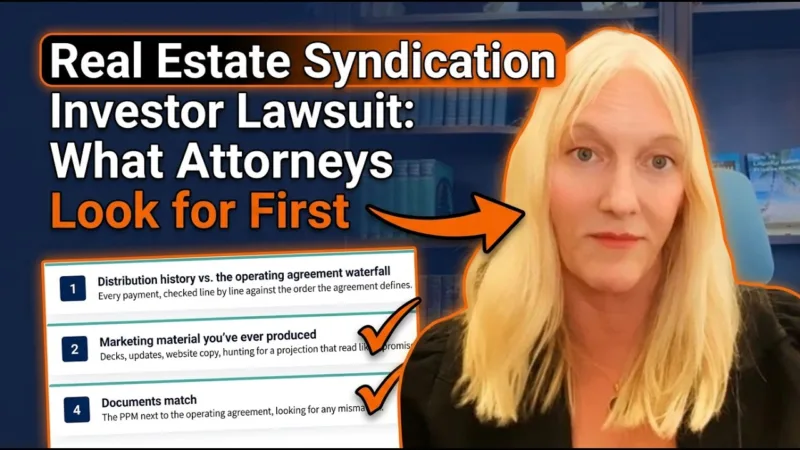
Your Investor Hired an Attorney. Here's Their Checklist.
Fund of Funds Sounds Easy in the Coaching Program. Here's What They Leave Out.
Free resource
Syndication or fund? A one-page guide
A quick-reference guide to picking the right structure, plus a copy of Kim's Amazon #1 best-seller, How to Raise Capital for Real Estate Legally.
Decision framework
The 6-step regulatory framework for a securities offering
Work through these six questions in order - each one narrows the structure, exemption, and compliance path for your offering.
1
Select the offering type
2
Select the corporate structure
3
Select the securities exemption
4
Determine the ICA exception
5
Determine ERISA limits for IRA investors
6
Is state RIA analysis required?
Questions
Questions sponsors ask most
How much does a syndication or fund cost, and what's included?
A complete offering syndication package starts at $15,000, while a fund starts at $20,000+, depending on your structure and how much you're raising. Out of pocket expenses for Blue Sky filings and entity formation can be $2,000-$8,000, depending on the number of investors and the formation states of your entities. Typical packages include your offering documents, entity structuring, a 2 hour deal structuring call, a drafting review call. SEC and Blue Sky (state) filings are available on request. See "What's included" and "Investment" above for the full breakdown.
How long does it take?
Most engagements move from structuring call to final documents in 2 to 4 weeks.
When should I bring in a securities attorney?
As soon as you have a signed purchase agreement, or even earlier if you're building documents around a target deal. See "When should you hire us?" above.
What happens if my deal falls through?
Your documents can often be adapted to a new deal without starting over, depending on how different the terms are.
Can I raise from family and friends without formal documents?
No - if they're passive investors putting in money, securities law applies whether or not they're related to you.
Should I use 506(b) or 506(c)?
506(b) lets you accept up to 35 non-accredited investors but bars general solicitation. 506(c) allows public advertising, but every investor must be verified as accredited. Your fundraising approach usually decides which one fits.
Can I use my existing LLC?
Sometimes - it depends on how the entity is currently structured and whether it's already taken on other activity. We'll review it during your consultation.
Can I raise from investors outside the U.S.?
Yes, with the right structure - this usually involves layering in a Reg S exemption alongside your domestic offering.
My coach recommended a different structure - can you review it?
Yes - we regularly review structures recommended by coaches or other advisors before you commit to one.
What happens after my documents are delivered?
You can start raising capital right away. We're still reachable for questions. And up to 2 hours of continuing phone support after delivery is included in every package.